
 Colombo: India's Rishabh Pant plays a shot during the second day of the second Test cricket match between Sri Lanka and India at the Sinhalese Sports Club in Colombo, Sri Lanka, on Monday, August 24, 2026. (Photo: IANS) Colombo, (IANS) India star batter Rishabh Pant shattered MS Dhoni's record for most Test runs scored by an Indian wicketkeeper away from home. The swashbuckling batter Pant went past Dhoni's feat during Day 2 of the second Test match against Sri Lanka at the Sinhalese Sports Club here on Monday. Pant scored a stroke-filled 63 in the first innings of the Test to go past the former skipper. Coming into the Test, the 28-year-old Roorkee man had scored 2471 runs in Tests away from home and at neutral venues. He needed to score 26 runs to get past the 2011 World Cup-winning captain, and he did so in style when he hit off-spinner Keshara Nuwantha for back-to-back fours in the 97th over of the first innings in the opening session on Day 2. Pant went on to complete his 21st Test half-century and a successive one after he had hit one in the second innings of the first Test in Galle. The Southpaw's impressive stay came to an end on the first ball of the second session when he drilled one straight to deep mid-off off Nuwantha. However, he has now scored 2534 runs as wicketkeeper away from home in Test cricket, with Dhoni now pushed back to second. Former cricketer Farokh Engineer had 1209 runs in away Tests as wicketkeeper, while Syed Kirmani made 1109 runs as wicketkeeper In the process, Pant has also surpassed former South African wicketkeeper Mark Boucher in the same record list and has the third-most runs away from home by wicketkeepers overall. The list is led by former Pakistan captain Sarfaraz Ahmed, who made 2696 runs away from home in 52 Tests. Australia legend Adam Gilchrist is second with 2634 runs in 41 Tests away from home or at neutral venues. Pant's knock also saw him close in on 3000 World Test Championship runs as he aims to become the first Indian to get there. Following his 63, the Southpaw now has 2948 runs in 42 Tests in WTC history as he stands 52 shy of the 3000-run margin.Coming to the ongoing Test, India batted at a strong rate in the first session of the second day and amassed 119 runs and lost only Saransh Jain's wicket. Pant and Dhruv Jurel were the stars with the bat as they both crossed half centuries with India piling the pressure on the hosts. Rishabh Pant scripts history, breaks Dhoni’s away Test runs record | MorungExpress | morungexpress.com
|
'We need players like him to play all formats': Dravid on Sooryavanshi (2026-09-15T15:42:00+05:30)
 'We need players like him to play all formats': Dravid on Sooryavanshi Harare: India's Vaibhav Sooryavanshi plays a shot during the third T20I match between India and Zimbabwe at Harare Sports Club in Harare, Zimbabwe, on Sunday, July 26, 2026. (Photo: IANS/X/@BCCI) New Delhi, (IANS) Former India captain Rahul Dravid believes the game needs players like Vaibhav Sooryavanshi to develop into all-format cricketers, while stressing the importance of giving the 15-year-old enough time and exposure to red-ball cricket. Sooryavanshi, who has already made an impact in white-ball cricket, is set to feature for East Zone in the Duleep Trophy as he looks to gain more experience in the longer format. Dravid, who coached Sooryavanshi at Rajasthan Royals in IPL 2025, said the youngster’s development needs to be carefully managed, with a balance between white-ball opportunities and red-ball cricket. “I think you always have to find that balance. And I think it’s a great thing that Vaibhav is getting the experience of playing some white-ball cricket through the IPL in India, but he’s also having the time to go back and play red-ball cricket in the Indian domestic system and grow his red-ball career,” Dravid told Cricinfo at an event in Dublin to unveil the European T20 Premier League (ETPL). “All of us also want to see Test cricket survive, all of us want to see Test cricket grow, and we need players like him to be able to hopefully play all formats of the game,” he added. Sooryavanshi has played only eight first-class matches so far, averaging 17.25, and Dravid believes the youngster needs a consistent run in the format to develop his red-ball skills. “The good thing is he’s going to take some time, he’s going to need some experience, he’s going to get an opportunity to play a lot of red-ball cricket. He’s not played as much red-ball cricket as probably white-ball cricket,” Dravid said. “He’s only 15, and I think you’ve got to just give him some time and you’ve got to be patient with him. He’s obviously been such a success straightaway, but he’s going to go through his ups and downs, and I think people are going to have to be patient with him,” he added. The Duleep Trophy could provide Sooryavanshi with at least two consecutive first-class matches, while a third could come if East Zone reach the final. He may also get further red-ball opportunities when India A host Australia A in two unofficial Tests in September. Dravid also believes Sooryavanshi’s decision to continue playing domestic red-ball cricket rather than chasing T20 opportunities around the world will benefit his long-term development. “I think he’s going to have some success, but he also might have periods where it probably doesn’t work out well for him. But let’s all remember he’s only 15 and he has a long way to go,” he said. “So Vaibhav Sooryavanshi, by not playing in T20 competitions all over the world, is actually playing in the red-ball Indian domestic competition. He’s growing, he’s getting better at red-ball skills.” Dravid hoped Sooryavanshi can eventually make the transition into red-ball cricket at the highest level and become an all-format player for India.“Hopefully, someday if he does well and performs well as he has in white-ball cricket, he might become a red-ball player for India. And how exciting that would be for the world game as well,” he said. 'We need players like him to play all formats': Dravid on Sooryavanshi | MorungExpress | morungexpress.com
|
West Indies forced into 2027 ODI World Cup Qualifier after missing automatic qualification (2026-08-17T12:27:00+05:30)
 Kolkata: West Indies' Shamar Joseph celebrates with teammates after the dismissal of India’s captain Suryakumar Yadav during the ICC Men's T20 World Cup 2026 match between India and West Indies at Eden Gardens in Kolkata district of West Bengal, Sunday, March 01, 2026. (IANS) New Delhi, August 11 (IANS) Two-time ODI World Cup champions West Indies will once again have to negotiate a qualifying tournament to reach the 2027 World Cup after failing to secure a place among the teams guaranteed automatic entry. The West Indies, who are currently placed 10th in the ICC ODI rankings, will not be able to secure one of the automatic qualification spots by the September 30 deadline even if they win both of their remaining ODIs versus India, they will have to take part in the Qualifier in February next year if they want to take part in the 2027 event in South Africa, Zimbabwe and Namibia. Automatic qualification will be granted to the top eight teams in the ICC ODI Rankings as of September 30, with the two host nations, South Africa and Zimbabwe, excluded. Afghanistan earned their spot in that group following their exciting win against Ireland in Belfast. Australia, India, New Zealand, Pakistan, Sri Lanka, England and Bangladesh - teams who are the defending championsc - will take part, together with the hosts South Africa and Zimbabwe. For the West Indies, this most recent development is once again a blow in their attempt to regain the top spot in the 50-over format; since they were not able to qualify directly, they had to take part in the Qualifier for the 2023 ODI World Cup and ultimately ended up in fifth position in the Super Six phase, thus missing the tournament completely. West Indies had never before failed to qualify for the men's ODI World Cup, and since their omission from the 2023 tournament they have also missed the 2025 Champions Trophy, a competition which they had not taken part in since 2013. The West Indies will therefore have to go through another difficult qualifying campaign, the 2027 World Cup Qualifier being held in February next year. It has not yet been decided which country will host the tournament. The team that wins the Qualifier will be given direct entry into the second round of the 2027 World Cup, while those who finish in second, third, and fourth places will have to take part in the first round, which is called the Super Series. The winner of that tri-series will progress to the second round of the World Cup. However, the reformed qualification system has not been well received by some Associate nations. The Qualifier will include Ireland and West Indies, who are the two lowest-ranked non-host Full Members in the ODI rankings as of 30 September 2026, together with the top four teams from the Cricket World Cup League 2. The other four places will be taken by teams that advance from the World Cup Qualifier Playoff; this eight-team playoff will include the four lowest-placed sides from the CWC League 2 and four teams from the Challenge League, which is essentially cricket's third division. The four teams that finish at the top in the playoff will be promoted to the World Cup Qualifier.The Challenge League includes 12 teams, which are divided into two pools containing six teams each. During the cycle, each pool will hold three round-robin tournaments, and the two teams at the top of each pool will progress to the World Cup Qualifier Playoff. West Indies forced into 2027 ODI World Cup Qualifier after missing automatic qualification | MorungExpress | morungexpress.com
|
‘Where is cricket going? The younger generation want more satisfaction’ (2026-07-28T12:10:00+05:30)

Former Australia cricketer Mark Taylor embraces day-night Test match idea
Sydney: Pink-ball day-night Test matches, which make their debut this week in Adelaide, should only be the beginning of a cricket revolution, former Australian captain Mark Taylor said on Monday. Taylor, a Cricket Australia board member, is advocating the introduction of four-day, 100-over Test matches and a clearly defined Test championship. He wants all Tests to begin on Thursdays, allowing them to build to a Sunday evening climax. "As someone said to me years ago, why are we surprised when people go to one-day cricket and T20 cricket more than they do a Test match, when we put all the one-dayers and T20s on in school holidays and at night," he told the Sydney Daily Telegraph. "And we put Test matches on during the week outside of school holidays." Taylor said he had discussed his ideas at an International Cricket Council level and they were now gathering some momentum with different options being brought forward. "You've got to look at the game as a whole. Where is cricket going? The younger generation generally want more instant gratification and I think over five days to keep them interested in the game is not so easy," he said. "People are more about who is the best in the world at the moment. They like watching World Cup finals if you're always working towards who is the best Test team in the world, that can only help the game." Taylor said a Test championship would likely include a similar scoring system to football, where three points are awarded for a victory and one given for a draw. Australia face New Zealand in the first-ever day-night Test in Adelaide from Friday and Cricket Australia has reportedly already contacted the Pakistan Cricket Board about securing a similar game in Australia for the next southern summer. The chief of the Federation of International Cricketers' Association, Tony Irish, warned against significant changes happening too quickly. He said that while players should be given credit for allowing this week's Adelaide Test to go ahead, it should be seen as an experiment. "This match needs to be seen strictly as an experiment. If there's one thing that everyone agrees on, it's that the pink ball in Test cricket is a big unknown," Irish told Fairfax Media. "The views of the players following the Test match have to be central to any future decisions."‘Source: The Asian Age, Image: https://upload.wikimedia.org
|
Young recalled for ENG Tests as NZ turn to familiar face after Williamson's retirement (2026-06-16T12:19:00+05:30)
 Karachi: New Zealand's Will Young walks off the field after his dismissal during the ICC Champions Trophy cricket match against Pakistan in Karachi, Pakistan, on Wednesday, February 19, 2025. (Photo: IANS) London, (IANS) New Zealand have called up top-order batter Will Young for the remainder of the Test series against England, with the 33-year-old set to fill the void left by Kane Williamson's retirement from international cricket midway through the tour. Young will arrive in England on June 14 and join the squad ahead of the second Test at The Oval, scheduled to begin on June 17. The recall offers Young a fresh opportunity at the highest level after he was initially overlooked for the England tour despite being one of New Zealand's most dependable reserve batters in recent years. Since making his Test debut in December 2020, he has featured in 23 matches, often stepping in when injuries or absences created openings in the top order. His return comes at a crucial time for New Zealand as they begin adjusting to life without Williamson, one of the country's greatest batters and a mainstay of the Test side for more than a decade. Young's strongest case for selection remains his impressive performances whenever entrusted with a larger role. The right-hander's most memorable contribution came during New Zealand's historic 3-0 Test series sweep of India in 2024. Batting at No. 3 in Williamson's absence, Young thrived in difficult conditions, scoring 244 runs across six innings and earning the Player of the Series award. His ability to handle quality spin and occupy a key position in the batting order makes him a natural candidate to strengthen New Zealand's lineup following Williamson's departure. Although Young has not played a Test since December 2025, selectors will hope his experience and adaptability can help provide stability during a significant transition period for the Black Caps.With New Zealand looking to remain competitive in the series against England, Young now has the chance to convert years of intermittent opportunities into an extended run in the side and establish himself as a central figure in the team's next chapter. Young recalled for ENG Tests as NZ turn to familiar face after Williamson's retirement | MorungExpress | morungexpress.com
|
Game changers: how a rainy week led a frustrated Don Bradman to reinvent cricket (2026-06-11T11:41:00+05:30)
|
Vaughan Cruickshank, University of Tasmania and Tom Hartley, University of Tasmania Sir Donald Bradman needs little introduction. Cricket – and possibly world sport’s – most dominant figure, “The Don” is known for his staggering batting feats, including a scarcely believable batting average of 99.94, and his leadership of Australia’s 1948 team nicknamed the “Invincibles”. However, few would know Bradman was a key figure behind cricket’s transformation from time-consuming five-day matches to the chaotic world of one-day and Twenty20 (T20) games that dominate the sport’s calendar, broadcasts and finances today. And it was all sparked by Melbourne’s oft-criticised weather, some worried bean-counters, and a bright idea. Sports can change dramatically in the blink of an eye. Sometimes, these moments create immediate shockwaves. Other times, it’s not until much later that their impact become obvious. This is the first story in a rolling series that explores key (and sometimes long forgotten) moments in sports history. The first one-day international Domestic one-day matches of between 40 and 60 overs a side had been played in India and England since the 1950s. These shorter, more dynamic games were aimed at attracting new spectators. However, they had not been considered for international matches. The first one-day international (ODI) in 1971 was an accident: an unscheduled match played as a last-minute replacement for a Test abandoned due to heavy rain. According to Australia’s captain Bill Lawry, the match was conceived by Bradman for financial reasons. Facing heavy financial losses the English and Australian cricket boards agreed to play a game on what would have been the last day of the Test. Around 46,000 spectators saw Australia win after each side was allotted 40 eight-ball overs. It was a financial hit, popular with spectators and deemed an “overwhelming success” by the media. But growth of this format was slow, mainly due to the conservative nature of international boards. The next ODI did not happen until August 1972, and other countries did not start playing them until 1973. Remarkably, considering the amateur status of women athletes at the time, the first limited-overs World Cup was a women’s tournament in England in 1973 – two years before the maiden men’s World Cup was played. One-day cricket’s popularity soon soared, especially after the men’s World Cup in 1975. Kerry Packer’s World Series Cricket, launched in 1977, confirmed its place on the international cricketing calendar and played a huge role in the shorter format’s popularity. The media baron was desperate to showcase cricket on Channel Nine but his TV rights bid was rejected by the Australian Cricket Board. Aggrieved, Packer instead set up a breakaway competition, signing many of the world’s best players. The new-look competition featured brightly coloured team kits, white balls, games under lights and batters wearing helmets – all of which are still in place today. How ODIs changed cricketTest cricket was, and often still is, criticised for being too slow and boring. The limited number of overs in ODIs increased the speed of the game: batters looked to score more quickly and take more risks, which resulted in more boundaries. Clive Lloyd, who captained the West Indies to two World Cup wins, called limited-overs cricket the greatest innovation for the sport. He specifically referred to improved standards of fielding and tactical awareness. ODIs have greatly increased athleticism: batters need to be stronger to hit more boundaries and quicker to ensure they are fast enough when running between wickets. Fielders need to be faster and more athletic to stop boundaries and extra runs. They also need stronger arms to throw the ball faster. In 1992, fielding restrictions were introduced for the first 15 overs, only allowing two fielders outside of a 30-yard circle. This promoted early aggressive batting. These fielding restrictions forced captains to rethink field placements and bowling rotations. While Australia scored 191 runs to win the first ODI, current teams regularly surpass 300. Scoring has increased because of power hitting, bigger bats, specific training and better running between wickets. Boundary ropes introduced for player safety also reduced the distance required to hit a boundary. Bowlers have had to develop more variations, such as slower balls, to make it harder for them to score runs. In this shorter format, the importance of all-rounders (players who can bat and bowl competently) has increased greatly. Wicketkeepers are also expected to be better batters. Former Australian wicketkeeper Adam Gilchrist had success opening the batting, which gave his team more flexibility to include other batters and all-rounders. Player uniforms also evolved. One-day clashes originally used traditional white clothing, but colour uniforms introduced a new dimension for televised cricket. They have been used permanently since the 1992 World Cup. As the format evolved, player names and then numbers were gradually added to playing tops, making identification easier for commentators and spectators. Continuing relevanceLimited-overs cricket laid the platform for even shorter formats such as T20s, the Hundred and even ten over games. Ironically, these innovative formats now threaten the continued relevance of 50-over cricket. Analysis of more than 340 ODI matches played in Australia between 1985 and 2015 shows average attendances have declined over time. In the 1980s, games in Australia regularly drew crowds of more than 35,000, but in recent years attendance has struggled to regularly reach 25,000 per match. However, major events like World Cups can still draw large crowds. The 2023 tournament was attended by a record 1.25 million people and made Australian captain Pat Cummins “fall in love with ODI cricket again”. ODIs have given fans decades of drama and achievement. Older fans still remember classic games such as Australia’s tied 1999 World Cup semifinal against South Africa, and Michael Bevan’s last-ball four to beat the West Indies on New Year’s Day in 1996. But 50-over cricket now faces a challenge to stay relevant alongside more exciting and more profitable T20 tournaments. If ODIs are to keep their place in a busy cricket calendar, they must continue evolving to ensure they maintain player and audience interest. Vaughan Cruickshank, Senior Lecturer in Health and Physical Education, University of Tasmania and Tom Hartley, Lecturer in Health and Physical Education, University of Tasmania This article is republished from The Conversation under a Creative Commons license. Read the original article. |

Sooryavanshi, a special talent… we are putting too much pressure on him: Kapil Dev (2026-06-10T13:15:00+05:30)
 Credit: BCCI/X New Delhi, June 8 (IANS) Former India captain Kapil Dev has described teenage batting sensation Vaibhav Suryavanshi as a "special talent," but cautioned against burdening the youngster with excessive pressure so early in his career. At 15 years and 71 days, the left-handed opener earned his maiden call-up to the India T20I squad for the upcoming tours of Ireland and England and the Asian Games 2026. He became the youngest player to be picked, breaking Sachin Tendulkar’s 36-year-old record. "I think he is a special talent, but he has to go a long way. There is no doubt that at such a young age, the way he has performed in club cricket shows his ability. He just needs to focus on himself because he has a long journey ahead. At the moment, I think we are putting too much pressure on him," Kapil Dev told IANS. Tendulkar made his India debut in 1989 against Pakistan at the age of 16 years and 205 days, making him the youngest Indian player ever to feature in a senior international cricket match. If Sooryavanshi features during the tour, he will also become the youngest player to debut for India in men’s international cricket. Sooryavanshi’s call-up comes on the back of a sensational IPL 2026 campaign with Rajasthan Royals, where he established himself as one of the breakout stars of the tournament. Opening the batting for the RR, the left-hander won the Orange Cap after scoring 776 runs in 16 innings at a staggering strike rate of 237.30. His season included one century, five half-centuries and a record 72 sixes. Asked about IPL have an impact on selection process, the 1983 World Cup-winning captain said, "Definitely IPL is the most important tournament in the world and with that selector must be watching who's playing you know which type of cricket and the selector have an option now they have people there who can be fit in the team at the right place."Before joining the senior squad for the Ireland series, Sooryavanshi is set to represent India A for the tri-series in Sri Lanka from June 9 to 21. Sooryavanshi, a special talent… we are putting too much pressure on him: Kapil Dev | MorungExpress | morungexpress.com
|
IPL 2026: Sooryavanshi scripts history, becomes youngest to clinch Orange Cap (2026-06-02T10:51:00+05:30)
 Gujarat Titans captain Shubman Gill greets Rajasthan Royals' Vaibhav Sooryavanshi as he walks off the field after his dismissal during the Indian Premier League (IPL) 2026 Qualifier 2 match between Gujarat Titans and Rajasthan Royals at the Maharaja Yadavindra Singh International Cricket Stadium, Mullanpur, New Chandigarh, on May 29, 2026. (IANS Photo) Ahmedabad, (IANS): Indian cricket's newest phenomenon, Vaibhav Sooryavanshi, has capped off a breathtaking Indian Premier League season by becoming the youngest-ever recipient of the Orange Cap, rewriting record books at just 15 years and 65 days of age. The Rajasthan Royals opener finished IPL 2026 with a staggering 776 runs from 16 innings, a tally that remained untouched after Gujarat Titans captain Shubman Gill and fellow opener Sai Sudharsan failed to mount a successful challenge in Sunday's final against Royal Challengers Bengaluru. With Rajasthan's campaign ending in Qualifier 2, Sooryavanshi had already completed his season. Yet his extraordinary run-scoring exploits ensured that no batter could catch him. Gill ended the tournament with 732 runs, while defending Orange Cap holder Sai Sudharsan accumulated 722. Virat Kohli, who was placed sixth before the summit clash between RCB and GT began, has scored 638 and surpassed SRH’s Klassen and Ishan Kishan to jump to fourth but still remains far from surpassing Sooryavanshi’s tally, ending fourth in the overall list. The teenager's achievement shattered another age-related benchmark. Until now, Sudharsan's Orange Cap triumph in 2025, at 23 years and 231 days, stood as the record for the youngest winner of the award. What separated Sooryavanshi from the rest was not merely the volume of runs but the manner in which they came. The Bihar-born prodigy scored at an astonishing strike rate of 237.31, producing an aggressive brand of batting rarely witnessed in the tournament's history. His six-hitting spree became one of the defining stories of the season. Sooryavanshi launched 72 sixes across the campaign, eclipsing the long-standing IPL record of 59 set by Chris Gayle and establishing a new benchmark for power-hitting excellence. The season was filled with milestones. Sooryavanshi became the fastest player in IPL history to reach 1,000 career runs in terms of balls faced, requiring only 440 deliveries and surpassing the previous mark held by West Indies powerhouse Andre Russell. In terms of innings, he reached the landmark in just 23 knocks, second only to Shaun Marsh's record of 21. His campaign could have been even more extraordinary. While he registered a century against Sunrisers Hyderabad, he also suffered the heartbreak of three dismissals in the nineties, scores of 93, 97 and 96 denying him a chance to match Kohli's record of four hundreds in a single IPL season. Nevertheless, the numbers scarcely capture the impact of his performances. Throughout IPL 2026, Sooryavanshi emerged as the tournament's most captivating storyline, combining audacious strokeplay with remarkable consistency against some of the world's best bowlers.As the curtain falls on a memorable season, Indian cricket finds itself celebrating not just an Orange Cap winner, but the arrival of a generational talent whose rise appears only to have begun. IPL 2026: Sooryavanshi scripts history, becomes youngest to clinch Orange Cap | MorungExpress | morungexpress.com
|
Test cricket: A fantastic game (2026-05-05T12:27:00+05:30)
 What a fantastic game of cricket is Test cricket. Yet, a few scribes I have read over the years, since the advent of the T20 version of the game, believe that it is on the way out, as it takes too long for the determination of a result and at other times they find it too boring. However, it is the epitome of the sport of cricket and most cricketers I have met throughout the years have expressed the wish to have played Test cricket or enjoyed it more than any other format. A bowler has to be wise enough to employ certain skills to fool a batsman into choosing the wrong delivery to play defensively to protect his wicket or off which to score. A batsman needs to be aware of which deliveries from the bowler he has to be wary of, in order to defend or consider an attacking stroke. A bowler and batsman have an ongoing battle, the batsman deciding from which deliveries to score and the bowler making it difficult to score. In Test matches (not unlike first-class cricket), which are always of a scheduled two-innings per team length, captains are not limited to restricted field-placing, but can position fieldsmen anywhere within the boundary that they find appropriate to place them. And this is where the strategy comes in, to trap the unsuspecting batsman into playing a false stroke, or in establishing a weak defensive position. The art is contained in the idea that the fielding captain is not restricted to certain positions on the field and could place his fieldsmen anywhere he feels that it is necessary to lure the batsman into a false stroke, subjecting him to dismissal. It is all subject to proper planning, with the intention of removing the opponent’s team for a low score. The fielding captain is not restricted to placing fieldsmen in certain positions on the field (except the one in all cricket that, not more than two fieldsmen are allowed behind square leg on the leg side). Thus, fieldsmen can be placed in strategic positions to trap the batsman by forcing him into error. The pitch is the surface on which the challenge of batsman and bowler takes place; if the pitch is conducive to spin, it gives the slow bowler the edge and if it is very hard and fast with a cushion of grass, the quick bowler has the advantage. That happened in two of the Test matches between Australia and England recently, which finished in two days. In the second one at Melbourne, even the groundstaff were in shock at 20 wickets falling on day one. In the second innings, Australia lost all their wickets and the game, while the Englishmen lost six wickets in getting the winning score. Hence, 36 wickets fell across 142 overs of play. Both the groundsmen and players were in a state of shock. Curator Matt Page, recruited to inject “life” in the wicket, commented after the game that leaving 10mm of grass on the wicket proved excessive. It just goes to show that in a Test match, human error is a powerful factor and many elements can determine the way the pitch plays and influence the outcome of a match. The preparation of a pitch for a five-day Test embraces many factors which adds to the interest of the unfolding of the game. It has a lot to do with the local weather. If it’s sunny and humid or dark and cloudy, depending on which, it would be the length of coverage-time for the wicket. The grass would hold more moisture when dark and cloudy and when sunny, water has to be added in order to give it the necessary volume of wetness required to last five days. A cricket pitch will always require proper batting technique in Tests, regardless. The pitch is the essence of the sport, thus batsmen should be prepared for any eventuality, whatever they may meet in a two inning cricket game. In the T20 game, it’s just one inning, fielding positions are limited and bowlers, whether bowling steadily or badly, are only allowed four overs maximum. The pitch needs insignificant preparation for a match lasting just one day. The crowds attending the first four Tests in Australia were fantastic, where, in the Melbourne Test, there was a record number of 97,000 plus, each of the two days. The drama, the variety and the skill of Test cricket is unparalleled.To each, his own enjoyment and satisfaction. Test cricket: A fantastic game - Trinidad and Tobago Newsday
|
IPL 2026: 'I was telling him about the madness with which he is batting', says Kishan on Sooryavanshi (2026-04-27T13:27:00+05:30)
 Jaipur: Rajasthan Royals' Vaibhav Sooryavanshi plays a shot during the Indian Premier League (IPL) 2026 match between Rajasthan Royals and Sunrisers Hyderabad at Sawai Mansingh Stadium in Jaipur on Saturday, April 25, 2026. (IANS/Raj Kumar) New Delhi, (IANS) Ishan Kishan marvelled at the fearless batting of teenage sensation Vaibhav Suryavanshi, admitting that even opposition players are left wondering “what the scorecard could have looked like” had the youngster batted longer. Suryavanshi on Saturday hammered a stunning 37-ball 103 for against Sunrisers Hyderabad, marking his second IPL century with this one made off just 36 balls. Reflecting on his conversation with the 15-year-old, Kishan said, “I was just telling him about the madness with which he is batting and how he is hitting. Sometimes, you are even scared thinking about what the scorecard could have looked if he had stayed for a few more overs. So, it was important for us to get his wicket. It was 228, it could have easily been 258. Cricket is all about comebacks. We got him out and made a little comeback there. That’s what I told him, ‘When I am playing against you, please go a little easy on my team. I know all your secrets and inside stories," Kishan told JioStar. Vice-captain Kishan played a brilliant knock of 74 runs as Sunrisers Hyderabad chased down 229 runs target in 18.3 overs and registered a dominant five-wicket win against Rajasthan Royals (RR). Speaking about his role at No. 3, Kishan emphasised the importance of anchoring the innings and making life easier for others in the batting order. “After having played for so many years as a No. 3 batter, if you are set, you look to score big and bat till the end. It makes the job easier for the other batters with you, as they don’t feel the pressure. That is my only thinking, to keep things as simple as I can, be in a good headspace, and just take it one match at a time. If we play good cricket, the rest of the team will learn from it. In the end, it’s a team sport. When you play good cricket, it rubs off on the others. I have also made a lot of mistakes, so my only aim is not to repeat them, which unfortunately, I did in the end in this game.” Kishan also opened up on his journey back into the Indian team, stressing the need for resilience and consistent performances rather than dwelling on setbacks.“When I wasn’t playing and was out of the team, I told myself I can’t cry or sulk about it. It’s the easiest thing to do for any sportsman. It might earn you the sympathy of a few people, you might even feel good about it, but it won’t get you anywhere. The only thing that could have gotten me back into the reckoning was runs. So, I just wanted to improve my game and score as many runs as I could, even if that meant hitting more sixes than any other batter. Only consistent run-scoring can bring you back into the team. If 300 runs in a season are not enough, score 400; if not that, score 500. At the end of the day, cricket is our daily bread. When you’re out of the team, you understand its importance and start respecting every game. You become hungrier, and that was my focus: to become the best.” IPL 2026: 'I was telling him about the madness with which he is batting', says Kishan on Sooryavanshi | MorungExpress | morungexpress.com
|
'Focus will be on Virat': Aakash Chopra backs Kohli for stellar IPL season over Dhoni and Rohit (2026-04-01T11:34:00+05:30)
 Bengaluru: Royal Challengers Bengaluru's Virat Kohli bats during a training session ahead of the Indian Premier League (IPL) 2026 at M. Chinnaswamy Stadium in Bengaluru on Thursday, March 26, 2026. (Photo: IANS) New Delhi, (IANS) Former India opener Aakash Chopra has backed Virat Kohli to be the standout performer in IPL 2026 ahead of MS Dhoni and Rohit Sharma, citing the right-handed batter’s fitness and consistency as decisive factors. Kohli played a pivotal role in RCB's title-winning campaign last year, scoring 657 runs at a strike rate of 144.71 and an average of 54.75, including eight fifties. “The focus will be on Virat Kohli again because the guy is so fit. Yes, there are gaps between series and he felt the pinch of those gaps in Australia, but once he started scoring runs, he found a way to be super consistent for months. “So, the kind of fitness that he has achieved over a period of time makes him the best suited, also because he is an opener. So, he has more time to work himself into form. The same is true for Rohit Sharma as well, but between the two of them, I still feel Virat Kohli has it a little easier just because of himself. That is the price he has to pay for the kind of fitness and legacy he has built,” said Chopra on JioStar. He also explained why Dhoni may find it tough to hit the ground running in IPL 2026. “It is a little difficult for Dhoni as well because he is on the wrong side of 40. For him, to not play anything for 10 months, turn up for the IPL and switch on, and also play at a number where he gets only 10-12 balls, is the toughest thing to do. Then there are also 20 overs of keeping, so his job is perhaps the toughest.” Chopra further noted that Rohit is expected to continue his aggressive approach at the top of the order and set the tone for other Mumbai Indians batters to get going. “When you are part of the batting order that the Mumbai Indians have, it is mandatory to set the tone for Rohit Sharma. Rohit does want to bat a certain way. He has already made his opinion very public. "But if you are part of a setup where there is Quinton de Kock at the other end, followed by Tilak, Surya, Hardik, Will Jacks or Sherfane Rutherford, and then Naman Dhir, what else is the option? You need to maximise the 20 overs, which basically means maximising the first six overs."So, yes, Rohit would be expected to bat the same way, see the ball, hit the ball, that is what I am thinking for the entire Mumbai Indians setup, unless the pitch is asking you to play a slightly different brand of cricket," he concluded. 'Focus will be on Virat': Aakash Chopra backs Kohli for stellar IPL season over Dhoni and Rohit | MorungExpress | morungexpress.com
|
T20 WC: ‘This victory is what I live for,’ says Hardik on redemption, hard work, and India’s historic triumph (2026-03-14T13:08:00+05:30)
 Ahmedabad: India's Hardik Pandya celebrates with his partner Mahieka Sharma after India won the ICC Men's T20 World Cup 2026 at the Narendra Modi Stadium in Ahmedabad on Sunday, March 08, 2026. (Photo: IANS) Ahmedabad, (IANS) All-rounder Hardik Pandya described India’s ICC Men's T20 World Cup triumph as a moment of redemption and validation of years of belief, saying winning trophies for the country remains the driving force of his career after India sealed a dominant 96-run victory over New Zealand in the final at the Narendra Modi Stadium on Sunday, successfully defending their title and becoming the first team to win the T20 World Cup at home and three times. Speaking of his journey and the emotions surrounding the triumph, Pandya pointed to the difficult phases he had overcome since the previous World Cup cycle. “I think in that (2024 WC final) scene, there was a lot of difficulty, a lot of things had happened, so this was more about taking redemption, making my fifth comeback. This victory is always what I live for. I have played cricket for this. I want to win trophies, I want to win as many trophies as possible for India,” he told the broadcasters after the win. 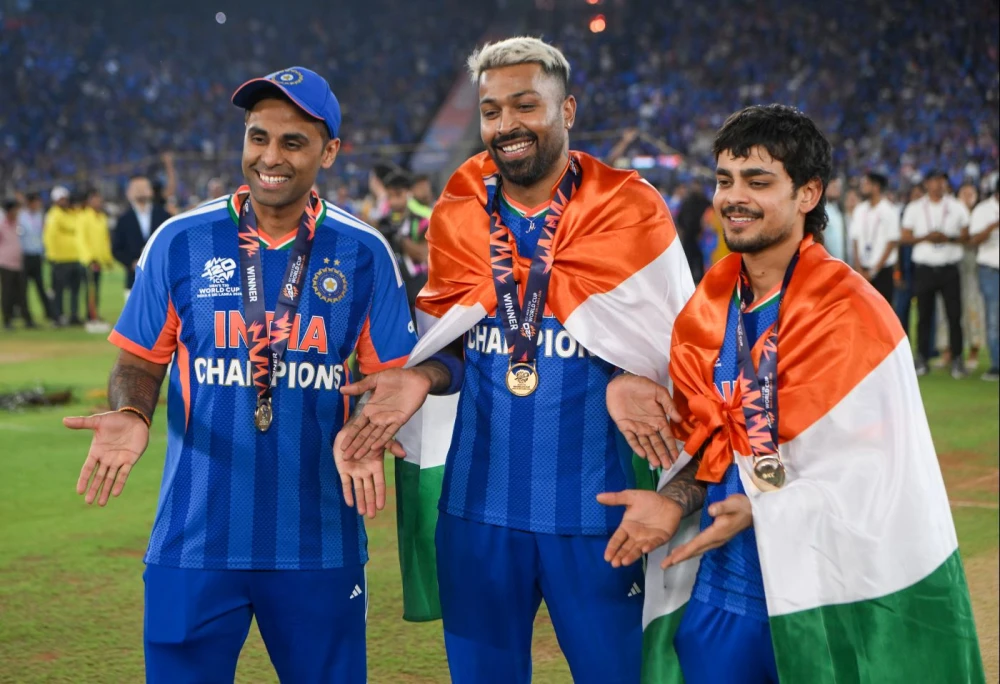 Ahmedabad: India's captain Suryakumar Yadav and teammates Hardik Pandya and Ishan Kishan celebrate after India won the ICC Men's T20 World Cup 2026 at the Narendra Modi Stadium in Ahmedabad on Sunday, March 08, 2026. (Photo: IANS) Ahmedabad: India's captain Suryakumar Yadav and teammates Hardik Pandya and Ishan Kishan celebrate after India won the ICC Men's T20 World Cup 2026 at the Narendra Modi Stadium in Ahmedabad on Sunday, March 08, 2026. (Photo: IANS)Pandya said his belief in winning trophies for India had never been just words. “After Barbados, I had said that whichever trophy I play for, I will win. I didn’t say that to say it, I believe it, and this is just a validation that what I believed has converted into reality,” he said. While he acknowledged the power of belief and manifestation, the all-rounder stressed that success ultimately comes down to relentless effort. “It is a manifestation, but I think there is a lot of hard work behind it; it is not just that, a lot of hard work goes into it. The big thing is everyone works hard, but for me, whatever results have come in life, I only know hard work. Every time I just work hard, work hard, be a good human being.” 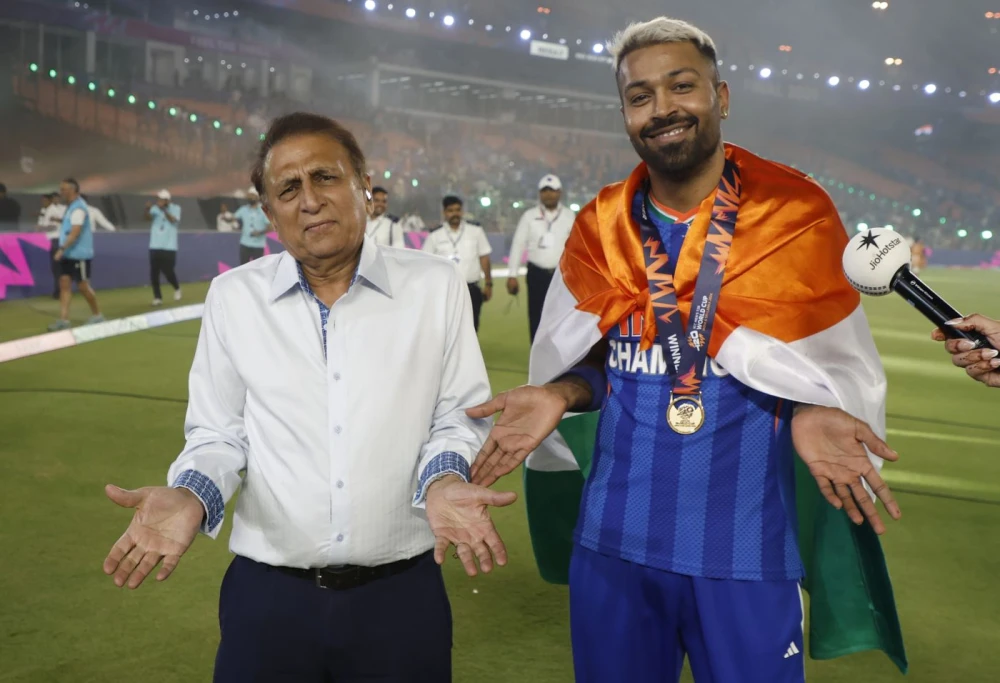 Ahmedabad: India's Hardik Pandya and former cricketer Sunil Gavaskar during the celebrations after India won the ICC Men's T20 World Cup 2026 at Narendra Modi Stadium in Ahmedabad on Sunday, March 08, 2026. (Photo: IANS) Ahmedabad: India's Hardik Pandya and former cricketer Sunil Gavaskar during the celebrations after India won the ICC Men's T20 World Cup 2026 at Narendra Modi Stadium in Ahmedabad on Sunday, March 08, 2026. (Photo: IANS)Pandya also credited the people behind the scenes who helped him stay physically and mentally ready through challenging periods in his career. “I would like to thank my own team, Mohit, Kartik, my physio, my security Siddhant, my nutritionist Nikhil, my trainers Sagar, and my chef Vijay. I think they have been fantastic. The Hardik Pandya you see is because these people take so much care behind the scenes.” He reserved special praise for his wife, saying her support had played a huge role in his recent success. “And since Mahika has come into my life, it has only been about winning, only about how Hardik Pandya can move forward. So special mention to Mahika, to my whole team. I think without them, I would not be here. This would not have been possible.” 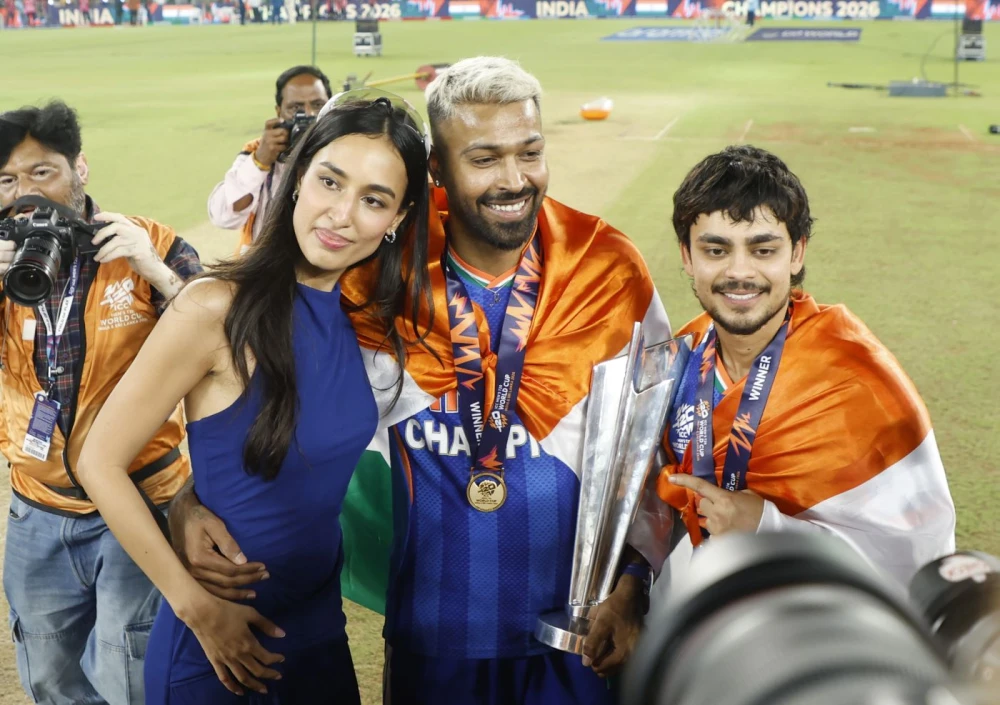 Ahmedabad: India's Ishan Kishan celebrates with teammate Hardik Pandya and his partner Mahieka Sharma after India won the ICC Men's T20 World Cup 2026 at Narendra Modi Stadium in Ahmedabad on Sunday, March 08, 2026. (Photo: IANS) Ahmedabad: India's Ishan Kishan celebrates with teammate Hardik Pandya and his partner Mahieka Sharma after India won the ICC Men's T20 World Cup 2026 at Narendra Modi Stadium in Ahmedabad on Sunday, March 08, 2026. (Photo: IANS)Now regarded as one of the senior players in the Indian setup, Pandya said he still has big ambitions for the next phase of his career. “I think it sounds very good that I am a senior player now. But I still have ten years left, so half of my career is finished, and half is still remaining. I want to win at least ten trophies, ICC and IPL combined, but for me, ICC trophies are the most important trophies.” He added that adding more global titles remains a major goal. “I have got three, and I would want to win anything that I play for. So I think in the next ten years at least five or six will come, so yeah, that’s my goal.” Winning a World Cup on home soil made the achievement even more special for the all-rounder. “Yes, it is a very emotional thing for me because winning a World Cup in India, the excitement of the people is a very big thing.” 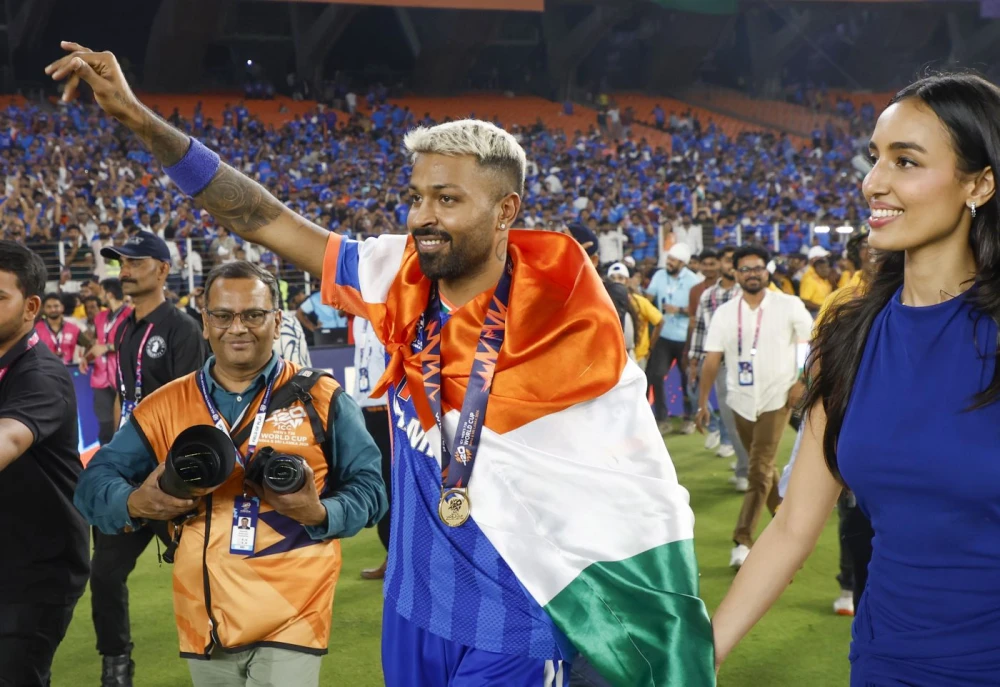 Ahmedabad: India's Hardik Pandya celebrates with his partner Mahieka Sharma after India won the ICC Men's T20 World Cup 2026 at the Narendra Modi Stadium in Ahmedabad on Sunday, March 08, 2026. (Photo: IANS) Ahmedabad: India's Hardik Pandya celebrates with his partner Mahieka Sharma after India won the ICC Men's T20 World Cup 2026 at the Narendra Modi Stadium in Ahmedabad on Sunday, March 08, 2026. (Photo: IANS)Pandya also reflected on the team’s belief heading into the final and key moments earlier in the tournament. “It feels like we won the match easily now, but the hard work this team has put in, from yesterday, I knew we are champions. I think that 19th over (in the semi-final vs England) was as important as what I bowled in the 2024 World Cup because I loved it.” For Pandya, the journey also carried a larger message about perseverance and humility. “I mean, this is what life teaches you. When you work hard, when you stay as humans, when you find happiness in other people’s happiness, the divine always gives you a chance. I think this is a learning for the whole nation that no matter what happens in life, if you keep working hard and stay quiet, the divine will take care.”He also praised teammates Sanju Samson and Ishan Kishan, both of whom played key roles in India’s title-winning campaign. “I am so proud of both of them. They came, they worked very hard, they kept quiet, and God has given them the benefit of what they have got now. So I am really proud of them.” T20 WC: ‘This victory is what I live fr,’ says Hardik on redemption, hard work, and India’s historic triumph | MorungExpress | morungexpress.com
|