
 Nisshin: India women’s cricket team players pose with their gold medals after defeating Sri Lanka in the women’s cricket final at the Asian Games 2026 in Nisshin, Japan, on Tuesday, September 22, 2026. India clinches the gold medal with a commanding 147-run victory over Sri Lanka. (Photo: IANS/Biplab Banerjee) Nisshin, (IANS) India women defended their gold medal after thrashing Sri Lanka in the final of the cricket event at the Korogi Sports Park here on Tuesday. The Women in Blue starred in both departments, with Smriti Mandhana's 79 leading them to a record 216/3 in the final, while Deepti Sharma, Shafali Verma, Shreyanka Patil and Sree Charani shared nine wickets to power India to a huge 147-run victory. This is India's first gold medal at the ongoing Asiad and overall seventh medal. The Women in Blue had won the gold in the previous edition of the Games too and have now defended their title against the same team. India scored the highest total in the history of the Women's Asian Games and also the highest score in a Women's T20 event final with a record-breaking performance in the gold medal clash. Mandhana was in top form as she made 79 from just 45 balls with seven sixes and five fours in a knock that saw her become the first player in women's cricket to complete 11,000 runs in international cricket. Shafali had another strong outing after her maiden white-ball hundred in the semifinal against Bangladesh as she made 48 from 29 deliveries laced with three fours and as many sixes. Richa provided the final push. She scored a brilliant unbeaten 49 from 22 deliveries, while Bharti Fulmali also made a run-a-ball seven to take India to a record 216/3 in the gold medal clash. The Women in Blue broke the record for the highest Asian Games score, which previously belonged to Hong Kong women, who had made 202/4 against Mongolia women in the 2023 Hangzhou Games. This is also the highest score in women's T20 finals, going past the previous 210 set by Brazil women in a quadrangular series final against Spain early this year in July. The bowlers did a stellar job too. Deepti was the pick of the bowlers with her three wickets, while Shafali, Deepti and Charani also picked two wickets each to bowl Sri Lanka out for just 69. Shafali started the damage when she got the wickets of Imesha Dulani and Hasini Perera before Deepti joined the party. The Indian all-rounder once again removed Sri Lanka skipper Chamari Athapaththu for 29, caught at long-off to nearly kill Sri Lanka's chances of a chase. The Sri Lankan side were never in the chase, as they kept losing wickets at regular intervals as they went all guns blazing at the improbable target. Deepti scalped two more, while No. 1-ranked T20I bowler Charani also got two. India finished the things when Shreyanka cleaned up the final Sri Lankan player, Kaushani Nuthyangana, for 14 to wrap up a huge win.Brief Scores: India beat 216/3 (Smriti Mandhana 79 off 45 balls, Richa Ghosh 49* from 22 balls; Chamudi Praboda 1-34, Kavisha Dilhari 1-35) Sri Lanka (Chamari Athapaththu 29 from 21 balls, Kaushani Nuthyangana 14 from 14 balls; Deepti Sharma 3-6, Shafali Verma 2-3) by 147 runs Asian Games: India women defend cricket gold after cakewalk win over Sri Lanka | MorungExpress | morungexpress.com
|
‘Where is cricket going? The younger generation want more satisfaction’ (2026-07-28T12:10:00+05:30)

Former Australia cricketer Mark Taylor embraces day-night Test match idea
Sydney: Pink-ball day-night Test matches, which make their debut this week in Adelaide, should only be the beginning of a cricket revolution, former Australian captain Mark Taylor said on Monday. Taylor, a Cricket Australia board member, is advocating the introduction of four-day, 100-over Test matches and a clearly defined Test championship. He wants all Tests to begin on Thursdays, allowing them to build to a Sunday evening climax. "As someone said to me years ago, why are we surprised when people go to one-day cricket and T20 cricket more than they do a Test match, when we put all the one-dayers and T20s on in school holidays and at night," he told the Sydney Daily Telegraph. "And we put Test matches on during the week outside of school holidays." Taylor said he had discussed his ideas at an International Cricket Council level and they were now gathering some momentum with different options being brought forward. "You've got to look at the game as a whole. Where is cricket going? The younger generation generally want more instant gratification and I think over five days to keep them interested in the game is not so easy," he said. "People are more about who is the best in the world at the moment. They like watching World Cup finals if you're always working towards who is the best Test team in the world, that can only help the game." Taylor said a Test championship would likely include a similar scoring system to football, where three points are awarded for a victory and one given for a draw. Australia face New Zealand in the first-ever day-night Test in Adelaide from Friday and Cricket Australia has reportedly already contacted the Pakistan Cricket Board about securing a similar game in Australia for the next southern summer. The chief of the Federation of International Cricketers' Association, Tony Irish, warned against significant changes happening too quickly. He said that while players should be given credit for allowing this week's Adelaide Test to go ahead, it should be seen as an experiment. "This match needs to be seen strictly as an experiment. If there's one thing that everyone agrees on, it's that the pink ball in Test cricket is a big unknown," Irish told Fairfax Media. "The views of the players following the Test match have to be central to any future decisions."‘Source: The Asian Age, Image: https://upload.wikimedia.org
|
Game changers: how a rainy week led a frustrated Don Bradman to reinvent cricket (2026-06-11T11:41:00+05:30)
|
Vaughan Cruickshank, University of Tasmania and Tom Hartley, University of Tasmania Sir Donald Bradman needs little introduction. Cricket – and possibly world sport’s – most dominant figure, “The Don” is known for his staggering batting feats, including a scarcely believable batting average of 99.94, and his leadership of Australia’s 1948 team nicknamed the “Invincibles”. However, few would know Bradman was a key figure behind cricket’s transformation from time-consuming five-day matches to the chaotic world of one-day and Twenty20 (T20) games that dominate the sport’s calendar, broadcasts and finances today. And it was all sparked by Melbourne’s oft-criticised weather, some worried bean-counters, and a bright idea. Sports can change dramatically in the blink of an eye. Sometimes, these moments create immediate shockwaves. Other times, it’s not until much later that their impact become obvious. This is the first story in a rolling series that explores key (and sometimes long forgotten) moments in sports history. The first one-day international Domestic one-day matches of between 40 and 60 overs a side had been played in India and England since the 1950s. These shorter, more dynamic games were aimed at attracting new spectators. However, they had not been considered for international matches. The first one-day international (ODI) in 1971 was an accident: an unscheduled match played as a last-minute replacement for a Test abandoned due to heavy rain. According to Australia’s captain Bill Lawry, the match was conceived by Bradman for financial reasons. Facing heavy financial losses the English and Australian cricket boards agreed to play a game on what would have been the last day of the Test. Around 46,000 spectators saw Australia win after each side was allotted 40 eight-ball overs. It was a financial hit, popular with spectators and deemed an “overwhelming success” by the media. But growth of this format was slow, mainly due to the conservative nature of international boards. The next ODI did not happen until August 1972, and other countries did not start playing them until 1973. Remarkably, considering the amateur status of women athletes at the time, the first limited-overs World Cup was a women’s tournament in England in 1973 – two years before the maiden men’s World Cup was played. One-day cricket’s popularity soon soared, especially after the men’s World Cup in 1975. Kerry Packer’s World Series Cricket, launched in 1977, confirmed its place on the international cricketing calendar and played a huge role in the shorter format’s popularity. The media baron was desperate to showcase cricket on Channel Nine but his TV rights bid was rejected by the Australian Cricket Board. Aggrieved, Packer instead set up a breakaway competition, signing many of the world’s best players. The new-look competition featured brightly coloured team kits, white balls, games under lights and batters wearing helmets – all of which are still in place today. How ODIs changed cricketTest cricket was, and often still is, criticised for being too slow and boring. The limited number of overs in ODIs increased the speed of the game: batters looked to score more quickly and take more risks, which resulted in more boundaries. Clive Lloyd, who captained the West Indies to two World Cup wins, called limited-overs cricket the greatest innovation for the sport. He specifically referred to improved standards of fielding and tactical awareness. ODIs have greatly increased athleticism: batters need to be stronger to hit more boundaries and quicker to ensure they are fast enough when running between wickets. Fielders need to be faster and more athletic to stop boundaries and extra runs. They also need stronger arms to throw the ball faster. In 1992, fielding restrictions were introduced for the first 15 overs, only allowing two fielders outside of a 30-yard circle. This promoted early aggressive batting. These fielding restrictions forced captains to rethink field placements and bowling rotations. While Australia scored 191 runs to win the first ODI, current teams regularly surpass 300. Scoring has increased because of power hitting, bigger bats, specific training and better running between wickets. Boundary ropes introduced for player safety also reduced the distance required to hit a boundary. Bowlers have had to develop more variations, such as slower balls, to make it harder for them to score runs. In this shorter format, the importance of all-rounders (players who can bat and bowl competently) has increased greatly. Wicketkeepers are also expected to be better batters. Former Australian wicketkeeper Adam Gilchrist had success opening the batting, which gave his team more flexibility to include other batters and all-rounders. Player uniforms also evolved. One-day clashes originally used traditional white clothing, but colour uniforms introduced a new dimension for televised cricket. They have been used permanently since the 1992 World Cup. As the format evolved, player names and then numbers were gradually added to playing tops, making identification easier for commentators and spectators. Continuing relevanceLimited-overs cricket laid the platform for even shorter formats such as T20s, the Hundred and even ten over games. Ironically, these innovative formats now threaten the continued relevance of 50-over cricket. Analysis of more than 340 ODI matches played in Australia between 1985 and 2015 shows average attendances have declined over time. In the 1980s, games in Australia regularly drew crowds of more than 35,000, but in recent years attendance has struggled to regularly reach 25,000 per match. However, major events like World Cups can still draw large crowds. The 2023 tournament was attended by a record 1.25 million people and made Australian captain Pat Cummins “fall in love with ODI cricket again”. ODIs have given fans decades of drama and achievement. Older fans still remember classic games such as Australia’s tied 1999 World Cup semifinal against South Africa, and Michael Bevan’s last-ball four to beat the West Indies on New Year’s Day in 1996. But 50-over cricket now faces a challenge to stay relevant alongside more exciting and more profitable T20 tournaments. If ODIs are to keep their place in a busy cricket calendar, they must continue evolving to ensure they maintain player and audience interest. Vaughan Cruickshank, Senior Lecturer in Health and Physical Education, University of Tasmania and Tom Hartley, Lecturer in Health and Physical Education, University of Tasmania This article is republished from The Conversation under a Creative Commons license. Read the original article. |

Test cricket: A fantastic game (2026-05-05T12:27:00+05:30)
 What a fantastic game of cricket is Test cricket. Yet, a few scribes I have read over the years, since the advent of the T20 version of the game, believe that it is on the way out, as it takes too long for the determination of a result and at other times they find it too boring. However, it is the epitome of the sport of cricket and most cricketers I have met throughout the years have expressed the wish to have played Test cricket or enjoyed it more than any other format. A bowler has to be wise enough to employ certain skills to fool a batsman into choosing the wrong delivery to play defensively to protect his wicket or off which to score. A batsman needs to be aware of which deliveries from the bowler he has to be wary of, in order to defend or consider an attacking stroke. A bowler and batsman have an ongoing battle, the batsman deciding from which deliveries to score and the bowler making it difficult to score. In Test matches (not unlike first-class cricket), which are always of a scheduled two-innings per team length, captains are not limited to restricted field-placing, but can position fieldsmen anywhere within the boundary that they find appropriate to place them. And this is where the strategy comes in, to trap the unsuspecting batsman into playing a false stroke, or in establishing a weak defensive position. The art is contained in the idea that the fielding captain is not restricted to certain positions on the field and could place his fieldsmen anywhere he feels that it is necessary to lure the batsman into a false stroke, subjecting him to dismissal. It is all subject to proper planning, with the intention of removing the opponent’s team for a low score. The fielding captain is not restricted to placing fieldsmen in certain positions on the field (except the one in all cricket that, not more than two fieldsmen are allowed behind square leg on the leg side). Thus, fieldsmen can be placed in strategic positions to trap the batsman by forcing him into error. The pitch is the surface on which the challenge of batsman and bowler takes place; if the pitch is conducive to spin, it gives the slow bowler the edge and if it is very hard and fast with a cushion of grass, the quick bowler has the advantage. That happened in two of the Test matches between Australia and England recently, which finished in two days. In the second one at Melbourne, even the groundstaff were in shock at 20 wickets falling on day one. In the second innings, Australia lost all their wickets and the game, while the Englishmen lost six wickets in getting the winning score. Hence, 36 wickets fell across 142 overs of play. Both the groundsmen and players were in a state of shock. Curator Matt Page, recruited to inject “life” in the wicket, commented after the game that leaving 10mm of grass on the wicket proved excessive. It just goes to show that in a Test match, human error is a powerful factor and many elements can determine the way the pitch plays and influence the outcome of a match. The preparation of a pitch for a five-day Test embraces many factors which adds to the interest of the unfolding of the game. It has a lot to do with the local weather. If it’s sunny and humid or dark and cloudy, depending on which, it would be the length of coverage-time for the wicket. The grass would hold more moisture when dark and cloudy and when sunny, water has to be added in order to give it the necessary volume of wetness required to last five days. A cricket pitch will always require proper batting technique in Tests, regardless. The pitch is the essence of the sport, thus batsmen should be prepared for any eventuality, whatever they may meet in a two inning cricket game. In the T20 game, it’s just one inning, fielding positions are limited and bowlers, whether bowling steadily or badly, are only allowed four overs maximum. The pitch needs insignificant preparation for a match lasting just one day. The crowds attending the first four Tests in Australia were fantastic, where, in the Melbourne Test, there was a record number of 97,000 plus, each of the two days. The drama, the variety and the skill of Test cricket is unparalleled.To each, his own enjoyment and satisfaction. Test cricket: A fantastic game - Trinidad and Tobago Newsday
|
T20 WC: ‘This victory is what I live for,’ says Hardik on redemption, hard work, and India’s historic triumph (2026-03-14T13:08:00+05:30)
 Ahmedabad: India's Hardik Pandya celebrates with his partner Mahieka Sharma after India won the ICC Men's T20 World Cup 2026 at the Narendra Modi Stadium in Ahmedabad on Sunday, March 08, 2026. (Photo: IANS) Ahmedabad, (IANS) All-rounder Hardik Pandya described India’s ICC Men's T20 World Cup triumph as a moment of redemption and validation of years of belief, saying winning trophies for the country remains the driving force of his career after India sealed a dominant 96-run victory over New Zealand in the final at the Narendra Modi Stadium on Sunday, successfully defending their title and becoming the first team to win the T20 World Cup at home and three times. Speaking of his journey and the emotions surrounding the triumph, Pandya pointed to the difficult phases he had overcome since the previous World Cup cycle. “I think in that (2024 WC final) scene, there was a lot of difficulty, a lot of things had happened, so this was more about taking redemption, making my fifth comeback. This victory is always what I live for. I have played cricket for this. I want to win trophies, I want to win as many trophies as possible for India,” he told the broadcasters after the win. 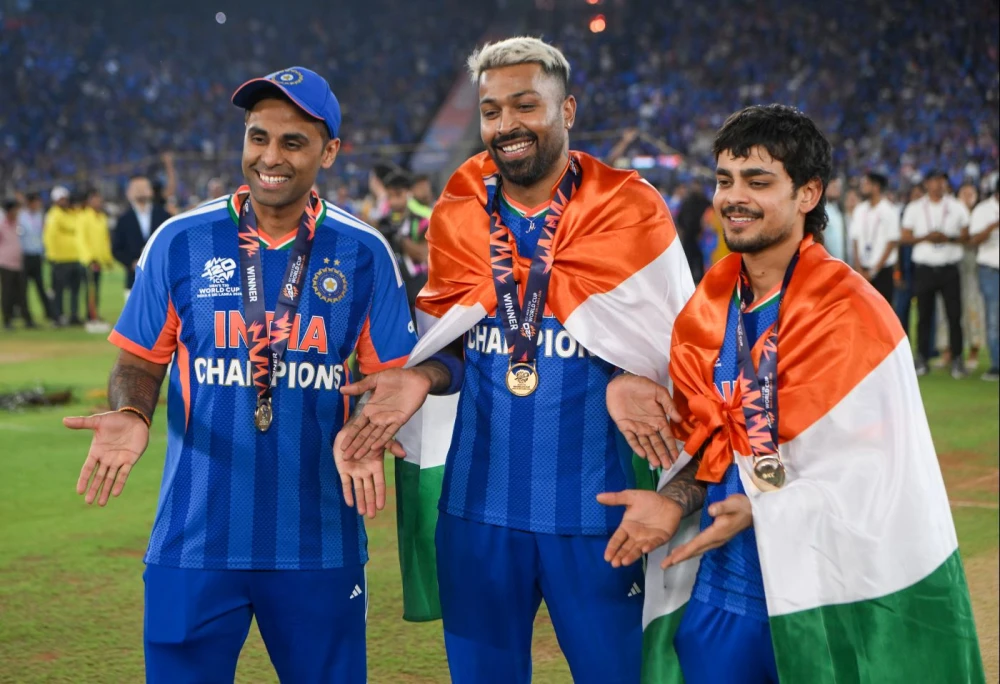 Ahmedabad: India's captain Suryakumar Yadav and teammates Hardik Pandya and Ishan Kishan celebrate after India won the ICC Men's T20 World Cup 2026 at the Narendra Modi Stadium in Ahmedabad on Sunday, March 08, 2026. (Photo: IANS) Ahmedabad: India's captain Suryakumar Yadav and teammates Hardik Pandya and Ishan Kishan celebrate after India won the ICC Men's T20 World Cup 2026 at the Narendra Modi Stadium in Ahmedabad on Sunday, March 08, 2026. (Photo: IANS)Pandya said his belief in winning trophies for India had never been just words. “After Barbados, I had said that whichever trophy I play for, I will win. I didn’t say that to say it, I believe it, and this is just a validation that what I believed has converted into reality,” he said. While he acknowledged the power of belief and manifestation, the all-rounder stressed that success ultimately comes down to relentless effort. “It is a manifestation, but I think there is a lot of hard work behind it; it is not just that, a lot of hard work goes into it. The big thing is everyone works hard, but for me, whatever results have come in life, I only know hard work. Every time I just work hard, work hard, be a good human being.” 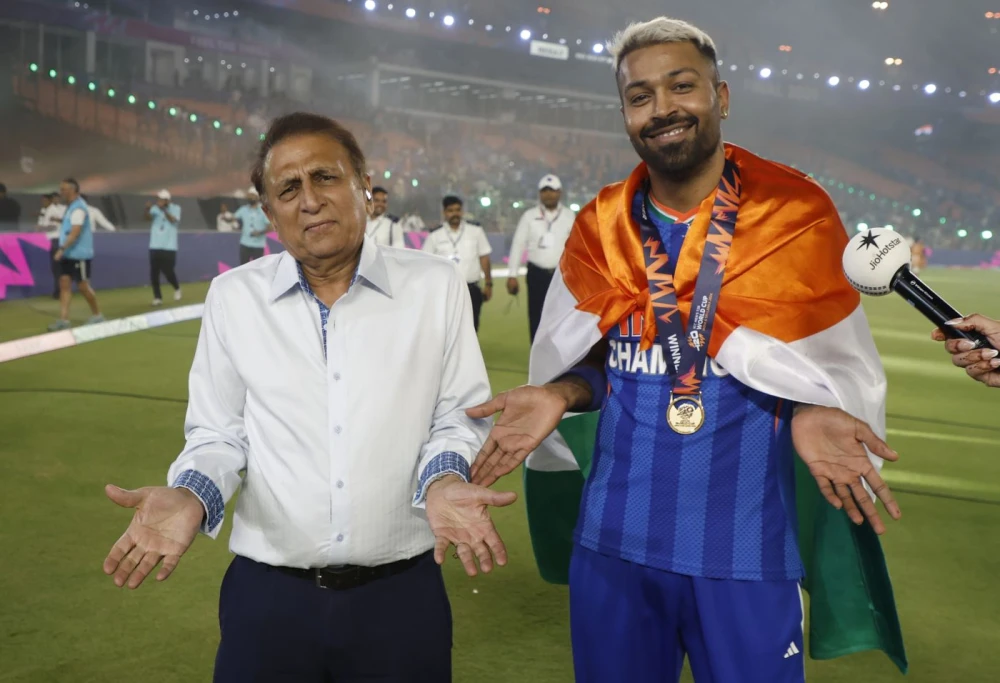 Ahmedabad: India's Hardik Pandya and former cricketer Sunil Gavaskar during the celebrations after India won the ICC Men's T20 World Cup 2026 at Narendra Modi Stadium in Ahmedabad on Sunday, March 08, 2026. (Photo: IANS) Ahmedabad: India's Hardik Pandya and former cricketer Sunil Gavaskar during the celebrations after India won the ICC Men's T20 World Cup 2026 at Narendra Modi Stadium in Ahmedabad on Sunday, March 08, 2026. (Photo: IANS)Pandya also credited the people behind the scenes who helped him stay physically and mentally ready through challenging periods in his career. “I would like to thank my own team, Mohit, Kartik, my physio, my security Siddhant, my nutritionist Nikhil, my trainers Sagar, and my chef Vijay. I think they have been fantastic. The Hardik Pandya you see is because these people take so much care behind the scenes.” He reserved special praise for his wife, saying her support had played a huge role in his recent success. “And since Mahika has come into my life, it has only been about winning, only about how Hardik Pandya can move forward. So special mention to Mahika, to my whole team. I think without them, I would not be here. This would not have been possible.”  Ahmedabad: India's Ishan Kishan celebrates with teammate Hardik Pandya and his partner Mahieka Sharma after India won the ICC Men's T20 World Cup 2026 at Narendra Modi Stadium in Ahmedabad on Sunday, March 08, 2026. (Photo: IANS) Ahmedabad: India's Ishan Kishan celebrates with teammate Hardik Pandya and his partner Mahieka Sharma after India won the ICC Men's T20 World Cup 2026 at Narendra Modi Stadium in Ahmedabad on Sunday, March 08, 2026. (Photo: IANS)Now regarded as one of the senior players in the Indian setup, Pandya said he still has big ambitions for the next phase of his career. “I think it sounds very good that I am a senior player now. But I still have ten years left, so half of my career is finished, and half is still remaining. I want to win at least ten trophies, ICC and IPL combined, but for me, ICC trophies are the most important trophies.” He added that adding more global titles remains a major goal. “I have got three, and I would want to win anything that I play for. So I think in the next ten years at least five or six will come, so yeah, that’s my goal.” Winning a World Cup on home soil made the achievement even more special for the all-rounder. “Yes, it is a very emotional thing for me because winning a World Cup in India, the excitement of the people is a very big thing.” 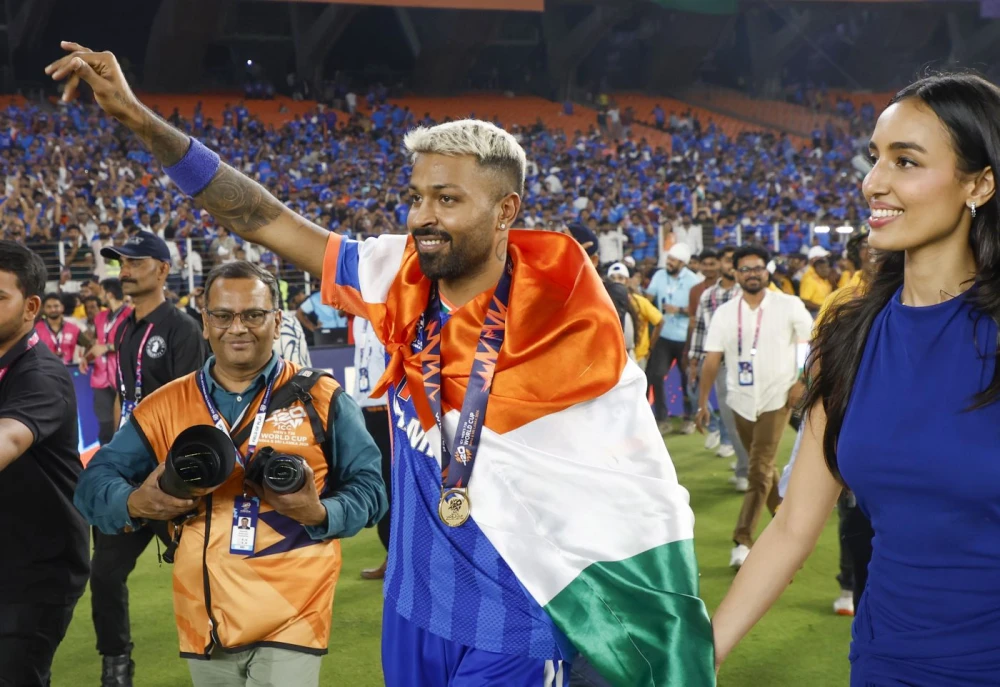 Ahmedabad: India's Hardik Pandya celebrates with his partner Mahieka Sharma after India won the ICC Men's T20 World Cup 2026 at the Narendra Modi Stadium in Ahmedabad on Sunday, March 08, 2026. (Photo: IANS) Ahmedabad: India's Hardik Pandya celebrates with his partner Mahieka Sharma after India won the ICC Men's T20 World Cup 2026 at the Narendra Modi Stadium in Ahmedabad on Sunday, March 08, 2026. (Photo: IANS)Pandya also reflected on the team’s belief heading into the final and key moments earlier in the tournament. “It feels like we won the match easily now, but the hard work this team has put in, from yesterday, I knew we are champions. I think that 19th over (in the semi-final vs England) was as important as what I bowled in the 2024 World Cup because I loved it.” For Pandya, the journey also carried a larger message about perseverance and humility. “I mean, this is what life teaches you. When you work hard, when you stay as humans, when you find happiness in other people’s happiness, the divine always gives you a chance. I think this is a learning for the whole nation that no matter what happens in life, if you keep working hard and stay quiet, the divine will take care.”He also praised teammates Sanju Samson and Ishan Kishan, both of whom played key roles in India’s title-winning campaign. “I am so proud of both of them. They came, they worked very hard, they kept quiet, and God has given them the benefit of what they have got now. So I am really proud of them.” T20 WC: ‘This victory is what I live fr,’ says Hardik on redemption, hard work, and India’s historic triumph | MorungExpress | morungexpress.com
|
T20 WC: ‘One of the greatest days of my life,’ says Samson after match-winning 97* powers India into semis (2026-03-01T13:23:00+05:30)
 Kolkata, (IANS) For a cricketer whose career has frequently oscillated between promise and doubt, salvation came on the biggest platform. Standing tall after guiding India to a historic chase against the West Indies at Eden Gardens, Sanju Samson reflected on a journey defined by resilience and belief. “It means the whole world actually to me. I think right from the day I started playing, started dreaming to play for the country, I think this is the day I was waiting for. And I’m very grateful, very thankful. And I’ve always had a very special journey with lots of ups and downs, but I’ve kept on doubting myself, kept on thinking, what if, what if, can I make it, can I make it? But I kept on believing and thanks to the Lord Almighty for actually blessing me today. So I’m very happy,” Samson said at the post-match presentation after being named Player of the Match. His unbeaten 97 off 50 balls was not merely a match-winning innings; it was the defining performance of India’s campaign in the ICC Men's T20 World Cup, sealing a semifinal clash with England. Samson’s innings was shaped as much by experience as by temperament, forged through years of watching and learning from the sidelines. “Yeah, I think that’s why I have been playing this format for a very long time. I think playing IPL around 10 to 12 years and playing for the country from last 10 years, I have not been playing, but looking from the dugout, learning from the greats like Virat Kohli, from Rohit Sharma, like all the greats. I think it’s very important to observe and learn and see what they were doing. I think that really helped me to, I think with my experience, I have only played maybe 50, 60 games, but I’ve seen around 100 games and I’ve seen how the greatest people have finished the games and how do they change their game according to the game,” he added. Chasing 195 in a virtual quarterfinal, Samson showed remarkable composure, adjusting his tempo as wickets fell around him. “So I think the last game we were batting first, so it was all about setting a very high score. So that’s how I wanted to go big right from ball one. But this game was completely different. I think as soon as I wanted to go a bit higher, we were losing wickets. So I think I wanted to build a partnership, wanted to keep focusing on my process. And I never felt that I will do something special like this, but I was just focusing on my role and just keeping one ball at a time and very grateful. I think this is one of the greatest days of my life,” he said of his knock. Even as the noise of expectation swelled, Samson relied on mental discipline to stay grounded. Speaking of the cheers from the crowd, Sanju stated, “Yeah, definitely they do bring a lot of energy and they do bring a lot of support. But I think on the other end, there is always a question, what if not? So definitely that keeps on playing in your mind. But when that thought kept on coming, I just brought myself into the present moment and just looked at the ball and trusted myself to react according to the ball in merit. So I think that worked out pretty well today.”On a night when India needed certainty, Samson delivered conviction, not just in runs, but in belief. The defending champions will now face England in the second semi-final on March 5 at the iconic Wankhede Stadium in Mumbai. T20 WC: ‘One of the greatest days of my life,’ says Samson after match-winning 97* powers India into semis | MorungExpress | morungexpress.com
|
T20 WC: Kishan credits simplicity, off-side game for match-winning 77 against Pakistan (2026-02-16T11:38:00+05:30)
 Colombo: India's Ishan Kishan plays a shot during the ICC Men's T20 World Cup 2026 match between India and Pakistan at the R. Premadasa Stadium in Colombo on Sunday, February 15, 2026. (Photo: IANS/Biplab Banerjee) Colombo, (IANS) India wicketkeeper-batter Ishan Kishan said being simple in his batting approach and focusing on opening up his off-side game helped him smash a match-winning 77 in the side’s 61-run win over Pakistan in a Group A clash at the R Premadasa Stadium on Sunday. Amidst the rain threat looming on the big clash, Kishan struck a blistering 77 off 40 balls laced with ten fours and three sixes on a slow, spin-friendly pitch as India posted 175/7 before bowling Pakistan out for 114 to secure a 61-run victory and qualify for the Super Eights. “I think the wicket was not that easy in the beginning, but sometimes you just have to believe what you want to play, what shots are on, and you have to just focus on your strength. “So I was just keeping it simple and watching the ball and playing with the field, maybe trying to make them run as much as they can, but yeah, I think it worked pretty well on my side,” Kishan said in the post-match presentation ceremony. Kishan, who was named Player of the Match, highlighted the work he had put into his offside game and the importance of rotating strike on a large ground. “I think I did work a lot on my offside game and it will give me the balls where I want them to bowl if I play good shots on offside. “So I was just trying to hit the gaps because it's a big boundary and when it's a big ground you get a bigger gap. So I was just trying to keep it simple, like I said, trying to hit the gaps, trying to at least take two runs because the wicket was not easy. I had that in mind that we need to put a total like 160-170 runs and it will be a very good total for us,” he added. Kishan further said the win carried added significance given the hype and rivalry around the India-Pakistan clashes. “100 percent. India v Pakistan is always a special game not only for us but for our country as well. So we had to win this one because it was a very important game and they had pretty good spinners in their side. “We were just supposed to play the good shots and winning this against Pakistan team... it will give us a lot of confidence going ahead in the tournament and we'll try to just keep the momentum going.” He also praised India’s new-ball bowlers for setting the tone. “I think they bowled tremendously well. Pace bowlers... when I was batting and Shaheen was bowling, I didn't feel like the ball was doing much for the pace bowlers. But at the same time, looking at them (Hardik Pandya and Jasprit Bumrah) bowl two beautiful overs, it was a plus point for us. “Especially when we know how Jasprit Bumrah can bowl, whether he has new ball in his hand and bowling in the death. Credit goes to Hardik Pandya for keeping it on the tight areas, bowling what we planned before the game and executing his plans pretty well,” he concluded. T20 WC: Ishan amazingly took the responsibility after being 0-1 down, says Suryakumar Captain Suryakumar Yadav praised wicketkeeper-batter Ishan Kishan’s match-winning 77 after India's 61-run victory over Pakistan in a Group A clash in the ICC Men’s T20 World Cup in Colombo on Sunday, saying that he took the responsibility of the innings amazingly after being 0-1 down. Kishan struck a blistering 77 off 40 balls, laced with ten fours and three sixes on a slow, spin-friendly pitch as India posted 175/7 before bowling Pakistan out for 114 to secure a 61-run victory and qualify for the Super Eights. “This is for India. We played the same brand of cricket we wanted to play. The way Ishan batted, he batted the same way (he has been batting in the last few games and domestic cricket). Ishan thought something out of the box. “At 0-1, someone needed to take responsibility, and he did that amazingly. There was a bit of a slump, but that is the beauty of T20 cricket. The way they (Tilak, Dube, and Rinku) batted is commendable,” Yadav said in the post-match presentation ceremony. India’s victory was their eighth in nine Men’s T20 World Cup meetings against Pakistan. Yadav also said the total was above par and credited his bowlers for sealing the win. “Difficult to tell when batting first. As soon as we reached 175, we thought it was 15-20 runs over par. 155, it would have been a very tight game. Hardik took the new ball, taking charge. Bumrah then showed why he is the best in the world. It was great to see everyone contributing,” he added. Looking ahead, the right-handed batter said the team would regroup well before their next fixture against the Netherlands in Ahmedabad, to be played on February 18. “We will think about that tomorrow. We will go back, have some good time together as a team (tonight), and think about that when we reach Ahmedabad.” Pakistan captain Salman Ali Agha admitted his side had fallen short with both bat and ball. “We went with four spinners; they had an off-day. Execution was missing in some parts. With the bat, we did not start well. If you lose 3-4 wickets in the Power-play, you are always chasing the game,” he said. “In the first innings, it was a bit tacky, and the ball was gripping too. The pitch played better in the second innings, but we did not bowl according to the situation, and we did not apply ourselves with the bat.“In these games, the emotions are always going to be high; we just need to deal with them. We have played enough (of these games), we have a game in a couple of days, and we have to look forward to it. We need to win that and qualify. Then it is a new tournament,” he said. T20 WC: Kishan credits simplicity, off-side game for match-winning 77 against Pakistan | MorungExpress | morungexpress.com
|
Vaibhav Sooryavanshi headlines ICC U19 team of the tournament (2026-02-09T11:57:00+05:30)
 Harare: India U19's Vaibhav Sooryavanshi plays a shot during the ICC Under-19 World Cup 2026 final against England U19 at Harare Sports Club, in Harare, on Friday, February 6, 2026. (Photo: IANS/X/@BCCI) New Delhi, (IANS) Vaibhav Sooryavanshi headlines ICC U19 Team of the Tournament as three of the Indian players feature in the 12-player list. Sooryavanshi scored an impressive 175 off 80 balls in the final against England and was named Player of the Tournament. He is joined by fellow players Kanishk Chouhan and Henil Patel in the 12-member squad. The selection panel was made up of Ian Bishop (Convenor), Lydia Greenway, Andy Flower, Telford Vice. Chouhan made important contributions with both bat and ball. Patel took 11 wickets, including a fantastic spell of five for 16 against the USA. Runners-up England also have three players in the squad, with Thomas Rew serving as captain and wicketkeeper. Rew finished the tournament with 330 runs, at a batting average of 66, with one of his outstanding performances being in the semi-finals where he scored 100 (not out) against Australia, contributing significantly to his team’s victory. Lumsden, with 16 wickets was the leading wicket-taker in the tournament, while Mayes topped the run-scoring charts with 444 runs (including 191 against Scotland) made the final selection along with Rew. Mayes fell short of one run from equalling the all-time record for the highest individual score at an ICC U19 Men’s Cricket World Cup, which had been set four days earlier by Sri Lanka’s Viran Chamuditha – who is also selected. Both Faisal Khan Shinozada and Nooristani Omarzai represented Afghanistan and played instrumental roles in Afghanistan making it to the semi-finals of the tournament. Faisal scored two centuries in the tournament (playing against Ireland and India) and Nooristani took 14 wickets in the tournament, with a best of five wickets for nine runs against Tanzania. Oliver Peake (captain of Australia) scored two centuries in the tournament (including one against West Indies and another against England in the semi-finals); along with Ali Raza (Pakistan) and Vitel Lawes (West Indies) made up the final selection for the tournament. Raza took 13 wickets going at just over four an over, while Jamaican left-arm spinner Lawes took 10 scalps in his five matches. ICC U19 Men’s Cricket World Cup 2026 Team of the TournamentVaibhav Sooryavanshi (India), Viran Chamuditha (Sri Lanka), Faisal Khan Shinozada (Afghanistan), Thomas Rew [wk, capt] (England), Oliver Peake (Australia), Ben Mayes (England), Kanishk Chouhan (India), Nooristani Omarzai (Afghanistan), Vitel Lawes (West Indies), Ali Raza (Pakistan), Manny Lumsden (England), Henil Patel (India) Vaibhav Sooryavanshi headlines ICC U19 team of the tournament | MorungExpress | morungexpress.com
|
Why the UAE is the Ideal Destination for International Cricket (2026-01-02T13:45:00+05:30)
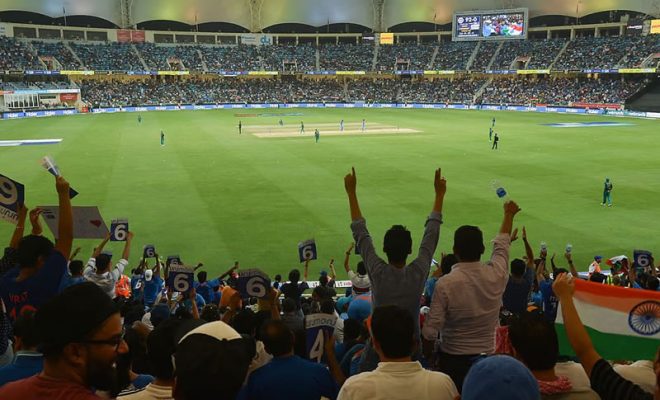 Every cricket fan globally follows the upcoming ICC Champions Trophy event with great excitement. Teams across the world are working on their plans to win the championship glory. These top nations maintain their dominance with Australia while India and England keep their positions while Pakistan, New Zealand and South Africa attempt to join them. Players from both the new and experienced generations will face challenging battles at this event. Despite intense competition worldwide the United Arab Emirates stands out by becoming the main center of cricket today. UAE: The Ideal Cricketing Destination The UAE has several modern cricket venues that bring energizing cricket action to sports lovers like Dubai International, Sheikh Zayed, and Sharjah Cricket Stadium. Top-quality venues at these locations enable players and spectators to enjoy cricket in its best form. The facilities host many spectators using modern lighting and surface treatments to create top-level views for all audiences. The UAE has successfully attracted major international cricket events through their network of new and updated stadiums while investing in cricket facilities. The UAE gains a key location benefit by being between major football world regions. Its location between Europe, Asia, and Africa enables visitors and competitors to arrive by multiple routes from every corner of the world. The UAE’s excellent hospitality services along with its well-connected transport systems and top-notch entertainment draws many people to its major cricket competitions. The UAE has hosted both the IPL and PSL events while being selected as a safe country for international tournaments. Weather and Infrastructure The UAE has an ideal weather that benefits cricket because of its sunshine and low rainfall. Many matches run smoothly in the UAE because there is little rainfall and sunny days almost every month of the year. The UAE maintains steady weather conditions throughout the year making other regions’ seasonal problems irrelevant to match postponements. High-quality playing spaces and improved training centers support effective cricket performance at this location.Alongside cricket the United Arab Emirates supports various infrastructure features that enhance this sport. The UAE offers top-quality lodging and exceptional hotels alongside event areas to delight players and spectators alike. Cricket tourism ranks high in Dubai because cricket fans love to attend games while exploring the sights of the city. The UAE keeps growing its cricket leadership position as the government partners with international cricket bodies and supports sports promotions. Why the UAE is the Ideal Destination for International Cricket |
Why do cricket balls have to be so hard? (2026-01-02T13:44:00+05:30)
John Arnold, University of South Australia and Tom Wycherley, University of South AustraliaThe game of cricket is believed to have originated in rural England sometime in the 16th or 17th century. The earliest versions of cricket balls had no standard size, weight or stitching: they were handmade by locals and consisted of a round leather case filled with materials such as cork or wool. As there were no set requirements or construction methods, each ball was different, and this affected how it bounced, moved and rebounded off the bat. However, cricket spiked in popularity in the first half of the 18th century, which prompted consistency in the rules and equipment to ensure fairness and facilitate further growth of the game. The modern cricket ballModern balls consist of four main components: a cork and twine (string) core, a leather casing, a raised middle section (the seam) with stitching on either side and a wax or lacquer coating. Balls are either red (for long formats such as international Test matches), white (for shorter formats such as One Day Internationals or Twenty20 games) or pink (for day-night Tests and first-class games). The laws of cricket state that when new, the ball should weigh between 5.5 and 5.75 ounces (155.9–163 grams) and have a circumference of 22.4–22.9 centimetres. For women’s cricket, the ball can weight slightly less (140–151g) and for junior cricket (under 13) even less again (133–144g). A set of technical standards was formalised in 1994 which stipulate the mechanical requirements for factors such as hardness, to help different manufacturers produce balls with more consistency and ensure fairness across the globe. So why are balls so hard?Cricket balls are the product of centuries of tradition and the extreme physical demands of the game. They must be robust and hard-wearing, able to withstand repeated high-force impacts from both the bat and the pitch over the course of a match. Consider the forces involved when a ball is struck by a bat. Reasonable estimates of peak forces when the ball is struck by the bat are about 17 kilonewtons (the weight of 1,700 kilograms) – enough to lift a 1.7 tonne car off the ground. The ball also repeatedly impacts the pitch at high speeds, experiencing shear forces that gradually wear its surface. On deteriorating pitches, this wear is even more pronounced. In Test cricket, a single ball can be bowled up to 480 times (80 overs) before the fielding team is allowed to request a replacement. While cricket ball construction has evolved over the past 300 years, its main elements have remained largely consistent. The introduction of the seam – the raised stitching that runs around the ball’s circumference – and the practice of shining one side of the ball to create swing are fundamental aspects of match play. These features allow bowlers to generate movement in the air – challenging batters and shaping the strategy of the game. The materials, construction and physical characteristics of the ball – including size, mass and density – determine its mechanical properties and influence how it bounces, spins and interacts with different surfaces and equipment. These properties are central to cricket’s nature and style – changing them would fundamentally alter the way the game is played. Tradition and the physical requirements of the game have ensured this construction is tried, tested and fit for purpose, creating the ball we know today. Is the ball dangerous?Bowlers vary their deliveries to deceive the batter and gain a tactical advantage. This can include changing the speed or where they aim the ball. A specific strategy fast bowlers may use is to aim to bounce the ball directly at a batter’s upper body or head (referred to as a “bouncer)”. This can be used to intimidate the batter and/or force them to make a mistake. Perhaps the most infamous example of this was the 1932–33 Ashes series, in which the English cricket team controversially used a consistent “bodyline” delivery approach to contain Australian batting legend Don Bradman. Various rule changes since the 1990s have limited the number of bouncers that bowlers can deliver, making the game safer. At the elite level, cricket balls are commonly bowled at speeds of 130–150 kilometres per hour. Occasionally, fast bowlers can exceed 160km/h. At amateur and recreational levels, bowlers commonly still reach 100km/h. When a person is struck – whether it be a batter, fielder or umpire – the ball hardly rebounds and the momentum is absorbed by the body. The force is also concentrated in a small area, making serious or even fatal injury possible – particularly if contact is made directly to the head. The exact force depends on the timing, location and angle of impact. But there’s no doubt the combination of a small, dense ball moving at high speed and stopping almost instantly makes cricket-ball injuries potentially deadly. There have been fatal incidents, albeit rare. The most high-profile such incident was the death of Phillip Hughes in 2014, who was hit on the neck in a Sheffield Shield match and died two days later from a vertebral artery injury. The number of deaths has declined significantly in the past 30 years, most likely due to widespread use of enhanced safety equipment, especially helmets, by batters and close-in fielders. So while a layperson may view cricket as a non-contact sport, the truth is batting and fielding require great courage, considering the hardness of the ball and the speeds it can reach. John Arnold, Senior Lecturer, Sport & Exercise Biomechanics, University of South Australia and Tom Wycherley, Associate Professor of Nutrition and Exercise Science, University of South Australia This article is republished from The Conversation under a Creative Commons license. Read the original article. |
